



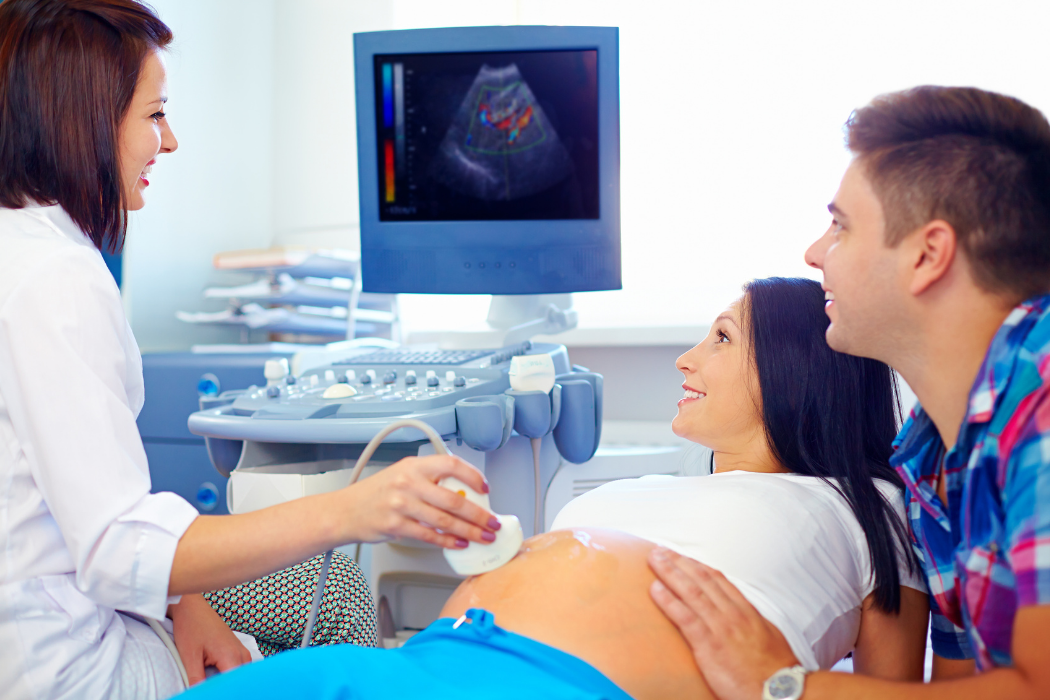


Whether it is at six weeks or 16, your first scan is one of the major pregnancy milestones.
It is both exciting and nerve-wracking – you cannot wait to see your baby but cannot help worrying if there is something wrong.
To help you make sense of what can happen, here are your questions about scans answered.
How do I arrange my first scan?
Once you have had your first visit with your GP, usually around eight weeks, you can plan your first scan. You will most probably be given a referral and be asked to arrange the appointment yourself. If your GP does not mention it, ask.
Should I urinate before my scan?
Having a full bladder can actually make your scan clearer. In early pregnancy, your uterus sits in your pelvis with your bowel covering it. A full bladder pushes your bowel out of the way so the uterus can be examined. You will usually be told to drink around one litre of water an hour before your appointment.
What exactly are they looking for?
Different things can be seen at different stages of pregnancy but the main purpose is to check the well-being of your baby, and to identify any potential abnormalities before the birth.
Can I have an earlier scan?
Some doctors will happily refer you for an early scan, particularly if you have had two or more miscarriages, but others may not be as keen as early scans do not guarantee all will be okay. Having said that, according to the UK’s Miscarriage Association, seeing a heartbeat at eight weeks increases the chance of continuing the pregnancy to 98 percent, and at 10 weeks it increases to 99.4 percent, so it may put your mind at ease a bit.
There are a number of reasons why an early ultrasound scan might be necessary. The common causes, besides those following a previous miscarriage, are to confirm uncertain dates, exclude multiple pregnancies, and review features that may have arisen because of any complications in a previous pregnancy.
You are likely to get an early scan if you experience any problems such as pain or bleeding. However, little can be seen before six weeks, so you may only be scanned if your doctor suspects you have got an ectopic pregnancy (where the embryo implants in a place outside the womb, usually in the Fallopian tubes, potentially causing some internal bleeding).
At six weeks, a heartbeat is seen about 50 percent of the time. Not seeing a heartbeat can be very scary but it does not mean you have lost your baby. Chances are you will be rescanned a week or so later – by eight weeks the heartbeat should be clearly visible.
Will I be able to find out the sex at 20 weeks?
Most women are offered a fetal morphology scan at about 18 to 20 weeks to check on their baby’s development. The sonographer will look at your baby’s major organs and skeleton, monitor your baby’s growth, and check the health of the placenta. It is also possible to tell the baby’s sex from about 16 to 17 weeks. There is about an 80 to 90 percent pick-up rate but your baby needs to be in the right position for the sex to be correctly detected.
I’m having a vaginal scan. What is it?
If you need an early scan you may be given an internal transvaginal scan, as the uterus is still tucked down in your pelvis and cannot be seen through the abdomen. It is not as bad as it sounds – the tip of the probe is the size of a tampon. Before the scan, the probe is cleaned and covered. The sonographer will put lubricant on it and gently insert it into your vagina. It would not increase the risk of miscarriage.
Does everyone get screened for Down Syndrome?

All women are offered screening for Down Syndrome and related conditions but methods vary. Most often you will be offered a nuchal scan between 12 to 13 weeks, where fluid at the back of your baby’s neck is measured (babies with Down Syndrome have increased fluid). Serum screening (blood tests) may also be done around this time. The pick-up rate is similar with both tests.
What will happen if abnormalities are found?
A number of babies have ‘ultrasound markers’ – slight deviations from the norm which may indicate conditions such as Down Syndrome – but are often completely fine. Still if an abnormality is found in the early scan it needs to be followed up. There are many options for following it up, which will depend upon whether the anomaly is minor or appears to be severe. It will also depend upon the abnormality which is found.
In all cases, it is important the apparent anomaly is discussed with the woman and that a plan is offered for a follow-up. The doctor has to determine whether it requires further investigation or management, or if it is of little consequence to the pregnancy’s outcome.
If you have further tests and it confirms a problem, all your options will be explained, including surgery or treatment after birth – or even in the womb – or in extreme cases, termination. You should be supported by a counsellor as well as the medical staff.
I wouldn’t terminate, no matter what. Do I still need a scan?
No one can force you to have any medical treatment, scans included. But even if you are certain you would not end your pregnancy if there were complications, it can still be a good idea to have a scan. Discovering abnormalities in advance means you can prepare yourself; it also helps the medical staff prepare so they can give you any treatment and ensure there will be specialists at the birth.
Will the scan hurt my baby?
Given how hard the sonographer pushes on your bump, it is easy to imagine your baby ending up black and blue. Do not worry – your baby will feel the pressure but the amniotic fluid acts as a cushion. There is no evidence that a scan, or repeat scans, can hurt the baby at any stage of pregnancy.
Do scans pick up all abnormalities?
Unfortunately, no. Severe abnormalities are easy to detect but problems can be missed, and certain conditions can develop after the scan. There is a 90 percent chance of major abnormalities such as spina bifida, missing limbs, and severe abdominal problems being picked up. However, there is only a 25 percent chance of spotting major heart problems, and
conditions such as autism and cerebral palsy are never detected on a scan.
I’m overweight. Will this affect the scan?
Carrying excess weight or being very muscular can make it harder to scan your baby, as the ultrasound waves have more tissue to pass through. The heart can be hard to see as it is so small and constantly moving. If they cannot get an accurate look, you will be rescanned later. If it still unclear, you may need a vaginal scan.
Will I get a photo to take home?

Once you have established your baby is okay, all you want to know is if you can have a copy of the first portrait to show to…well, everyone who crosses your path. You are almost always given at least one photo, although you could always ask for more. Do not laminate your picture to preserve it – the heat will destroy it. Photocopy those precious originals instead.
Are 3D/4D Scans Safe?
Surprisingly, even conventional ultrasounds are not proven 100 percent safe. But as they have been used for such a long time they are assumed safe. With 3D/4D ultrasounds your baby is scanned continuously for around 20 minutes, increasing any risks. It is recommended you only have scans on medical grounds.