





You’re pregnant and you have another child, you’ll want to prepare him/her for the birth of the new baby in a way that reduces sibling rivalry. But how to prepare your firstborn for a new baby sibling?
Here are some tips to reduce sibling rivalry and foster a close sibling bond right from the start.
1. Cultivate the relationship

First and foremost, cultivate the relationship between the older child and your spouse throughout the pregnancy. It will be so helpful especially when you’re nursing the new baby nonstop, you may want your older child to be excited about spending time with Dad.
2. Encourage your child’s connection to the baby by:
- Referring to “Our baby” or “Your sister” or even “Your baby.” The more ownership they feel — and of course, the less they feel displaced — the less jealousy they’ll exhibit.
- Reading books about childbirth with him.
- Taking him with you to the doctor to hear the baby’s heartbeat.
- Letting him pick out furniture toys and clothes.
- Letting him help you paint the baby’s room.
- Pondering potential baby names together (if you can let him “name” the baby with a name you love, all the better.)
- Packing a bag together for the hospital that includes a photo of him

3. Make sure your child knows he’s still important
You should make sure that your child knows he or she still has an important role in the family. He’s always been the baby and he’s about to be displaced. Now he’s the big brother. But he’s also the apple of your eye and a capable “big” kid.
Make sure you reinforce all the wonderful things about who he is and how he contributes to the family. “Josh, I love the way you help me,” or “Sara, I love the way you make me laugh,” which note specific contributions. Help your child develop a sense of why he’s still a valuable member of the family.
Talk often about the fact that each member of the family is important in their own way and makes their own special contribution. The family needs each person for it to be whole.
4. Let your child express his full range of feelings
Help your child express his full range of feelings throughout the pregnancy, birth, and afterwards, responding with empathy.
Naturally, he will feel some jealousy of all the time and attention you and everyone else are giving to the new baby. Reassure him with your words and actions that you adore him, and be sure to spend “special” time just with him each day. While it’s fine to emphasize the advantages of being older, it’s ok to reassure him that he will always be your baby, too, and to baby him a bit. Some older sibs will want to “play” baby, and that’s fine. He won’t regress forever.
5. Get any big changes out of the way
Get any big changes out of the way well in advance of the birth, such as room changes, weaning and toilet training. She needs time to make these new routines into habits without associating them with the baby.
6. Keep your relationship smooth with your firstborn
Keep your relationship with your older child as smooth and affectionate as possible, side-stepping power struggles and minimizing conflicts. She needs to be secure in your love to handle the arrival of a sibling with equanimity. Naturally, she’ll be testing you to be sure you still love her.

7. Emphasise that he is special
Emphasise the older child’s specialness by going through his baby pictures and talking about what a wonderful baby he was, and what a wonderful boy he is now.
8. Sibling birth classes
You might consider sibling birth classes, which offer lessons on how to hold a baby, explanations of how a baby is born, and opportunities for your child to discuss his or her feelings about having a new brother or sister. If you do this education yourself, be sure your child understands that babies cry a lot at first and aren’t ready to play for a long time, but that the baby will always look up to big brother and want his attention and care.
9. Discuss ahead on who will care for your firstborn during the birth
You’ll need to decide and discuss with your older child who will be with him during the birth itself. This can be a difficult time for the older sibling. Be sure he has the opportunity during a “trial run” to spend the night with whoever will care for him.
10. Consider having your older child be part of the birth process
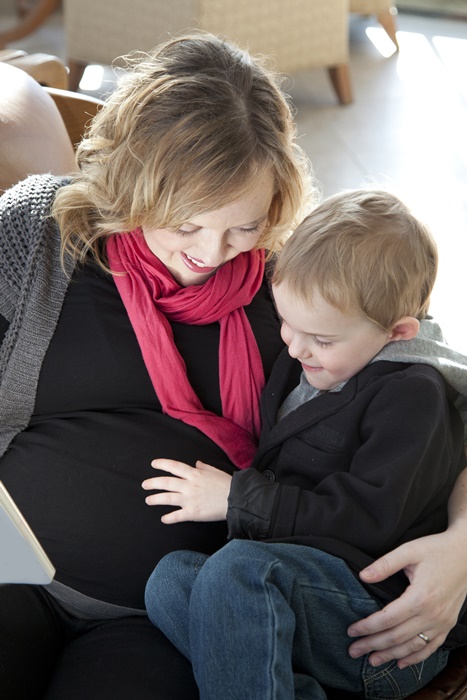
You might consider having your older child be part of the birth process. Prepare him by reading lots of birth books. Nowadays, there are great birth videos that are appropriate for children. His reaction can be a useful indicator as to whether he’s ready to attend the actual birth.
11. Prepare your child for observing a birth
A classic way to prepare a child for observing a birth is to let him help you push a large piece of furniture across the room. Point out that making loud noises, straining and sweating helps you work harder, and that labour is even more work. It’s important that your child knows what to expect, including that the baby might look odd, that the cord bleeds when it’s cut, and that it doesn’t hurt baby.
12. If your child is not present at the birth, you will want him to visit you ASAP
Get your child visits you as quickly as possible after the baby is born, before other visitors. Emphasize your joy at seeing him, rather than your preoccupation with the new baby. Then let him sit and hold the baby, helping him to support her head. Dr. Lawrence Aber, a bonding expert, says that babies’ heads give off pheromones, and when we inhale them, we fall in love, and begin to feel protective. The more your older child snuggles his new sib, the better their relationship is likely to be.

13. Surprise him/her with big brother/sister gifts
Privately ask visitors and family to give “big brother or sister” presents instead of “new baby” presents. It will help your oldest to feel like there’s indeed something to celebrate. And be sure there’s a special gift from the new baby to the older sib!