






Games, social media applications, funny videos; the internet is an obstacle course for children’s attention spans.
In the past months, as tuition classes and schools moved online to mitigate the spread of the pandemic, these distractions became a problem that could not be dealt with by simply switching off.
But there’s more to the screen than just distraction: What games your child plays can tell you important things about what motivates your child, and how you can help your child learn – and these are lessons you can apply, even as schools reopen and children make their way back into their classrooms.
Every child is different
If you’ve watched your child play games, and thought to yourself, “If only they were as focused on their studies.” — then you should know that concentration is not the problem. The issue is motivation. It might look like games have unlocked what makes children tick, but not all games are the same: For example, chess is a game, but not everyone loves to play chess; soccer (real or virtual) is a game, but not everyone loves to play soccer.
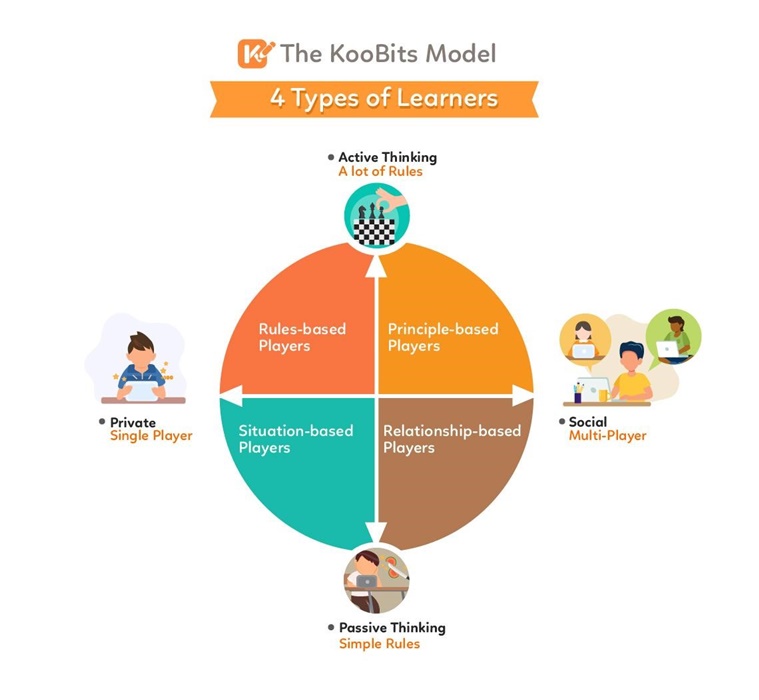
Just like different players are motivated in different ways, different learners are also motivated differently. However, the way most education is delivered, especially in schools, caters to only one type of learner. To help your child excel, you need to understand what motivates them. From our experience gamifying the Maths learning journey for kids at KooBits, we’ve identified four different types of learners, along two axes.
Rule-based Players
The rule-based players are likely to flourish in schools: If schools were a game, it would be characterized by clear and well-defined rules, and an individualistic mindset. They may enjoy games like chess, a highly-structured competitive game, with many rules and a few players.
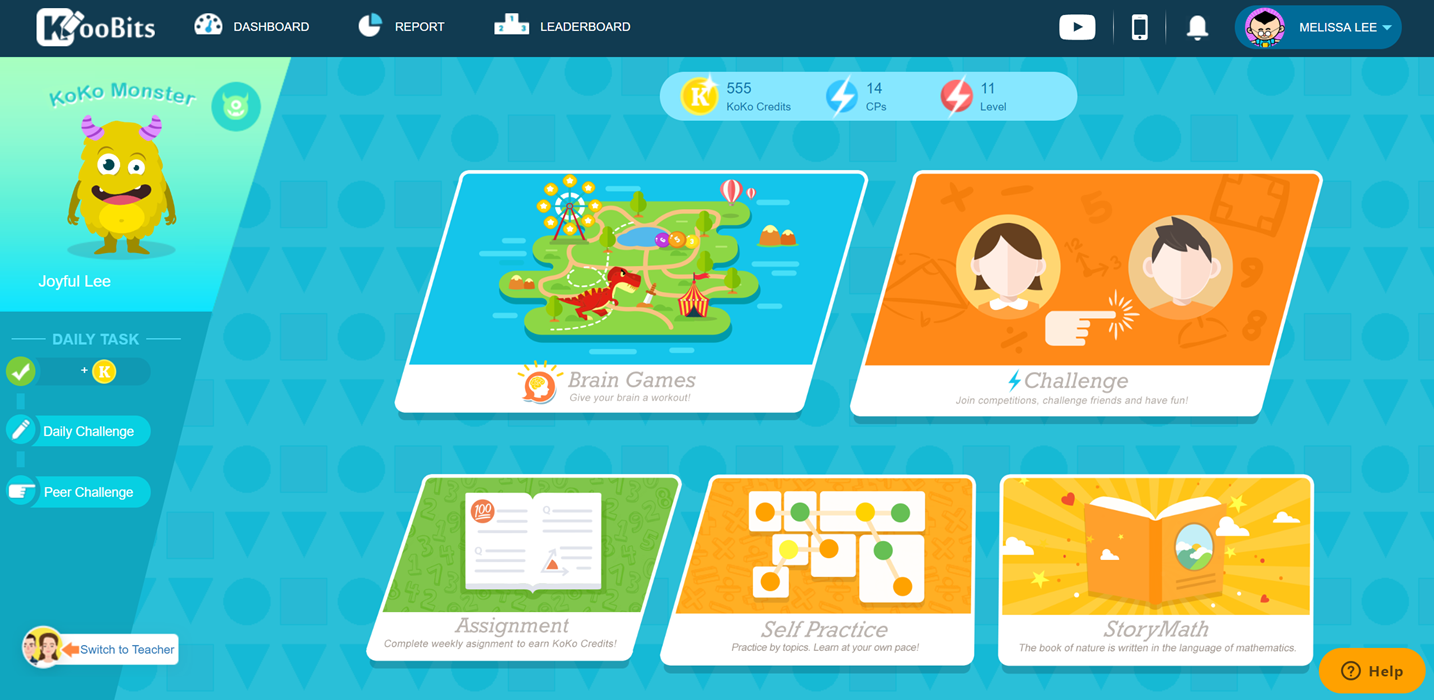
We’ve found that these players are motivated when they are rewarded for abiding by the rules and excelling at the rule-based challenges. On KooBits, one way we motivate these players is through the “Hero of the Day” achievement — where students complete 10 Maths questions everyday in order to earn the “Hero of the Day” badge. It is a fixed routine, with fixed rules, and a consistent reward: Players can expect to earn the virtual badge every day, for as long as they complete the necessary task. Collecting this daily achievement then becomes a big driving force that makes them want to regularly revise maths on the platform.
Recommendations for parents
If your child is a rule-based player, they will do best in a structured environment with regular positive reinforcement. For them to excel, you need to define the rules, setting clear boundaries, and milestones. Articulate what you expect from them, and the rewards and consequences — for example, achieve a set of learning targets for an exciting family outing. Most importantly, these should be tasks that the child can complete independently.

Principle-based Players
Principle-based players are like rule-based players in that they do best in an environment with rules, but unlike rule-based players, they are not motivated by solo challenges. Rather, they are motivated by figuring out the “hidden” social dynamics and rules in a complex world with many other players. If your child enjoys duking it out for rankings in competitive video games like Fortnite and Apex Legends, they might be a principle-based player. Conversely, they are unlikely to be interested in games without an element of social complexity, like chess.
On KooBits, we motivate these players through our leaderboards, like Champion Class, or BFF challenge: In order to win and rank higher on the KooBits leaderboard, these children must work in groups — completing questions on an individual basis is not enough to secure a win. The players must work with their peers, encouraging and helping their classmates to level up together. The dual challenges of understanding the rules of the leaderboard, and managing the unpredictable dynamics of social interaction motivates principle-based players, who lead the pack in taking on the leaderboard.
Recommendations for parents
If your child is a principle-based player, they flourish in environments with complex rules that they have to figure out on their own. Set challenges with complex and layered tasks, and give them freedom and space to make sense of it on their own. Let them figure out the rules and social dynamics, and define their own principles to success in a complex environment. They might do well in roles of student leadership, navigating the challenge of maintaining high academic scores with the additional social challenge of leading their peers.
Relationship-based players
Where principle-based players do best in environments with many rules and many players, relationship-based players blossom when there are many players, but few rules. This group of players don’t enjoy the fierce competition that rule- and principle-based peers gravitate towards, but do best when working together with other players in games with very simple rules that anyone can learn. Minecraft is an example of a relationship-based game, where there are few competitive stakes, but plenty of opportunity to socialise.
On KooBits, these players have the most fun with the StoryMath Book Club. With this feature, they unlock chapters of a story as they complete maths challenges, and are able to see what chapters their network of friends are reading. There is no competition, ranking or rules. Rather, these players enjoy the communal element of reading the same books or chapters together, with the online book club encouraging students to speak to their real-life friends about the stories they have unlocked and read. This social element then motivates them to complete more maths challenges and unlock more chapters.
Recommendations for parents
Most of these children do not favour strict environments with many rules. As such, it would be best to avoid placing them headfirst in environments with many rules or instructions, or with fierce competition or peer pressure to achieve. The social element is a big motivator for them: Get them excited about learning something new, or enrolling into them in a new class, by emphasizing the social element — like the opportunity to work with their peers, or to make new friends.
Situation-based players
Most situation-based players are not interested in too much competition or socializing, and most enjoy solo play of games with simple rules. The games, however, cannot be static: Situation-based players require a dynamic environment to keep them engaged. If your child enjoys games like Temple Run or Candy Crush — with intuitive, simple rules, but dynamic level design — they might be this sort of player.
These sorts of players take on challenges independently, at their own time and pace. On KooBits, they do best at Mission mode, a self-paced self-practice challenge that has them tackling maths problems stage by stage.
Recommendations for parents
Like relationship-based players, these children do not prefer competitive environments with peer pressure. However, they flourish in stimulating environments that constantly challenge them. They also handle independence well, as long as the rules are simple, and they are given the freedom to proceed at their own pace.
KooBits Home-Based Learning: Personalized Maths learning for every Child
Getting a child to want to learn is not simply a matter of dumping a pile of assessment books in front of them. In fact, that might even have the opposite effect. You need to understand what motivates the child: Is it competition or cooperation? Do they like unlocking achievements, or finding new things?
This is something we have come to understand through our experience in creating a Maths e-learning platform for children. We designed different motivation strategies for different types of learners — a total of 42 motivation strategies, which we call them “motivation dynamics”. The result is students who are engaged and self-motivated to practice and improve on their maths skills on our online platform, without sacrificing the serious (sometimes tedious) element of education and learning.
Our new ‘Home-Based Learning’ module comes with access to unlimited worksheets with full solutions, and comprehensive video tutorials. These tutorials are based on the Concrete-Pictorial-Abstract (CBA) approach, ensuring that children do not simply rote-memorise the steps to solving a problem, but are able to visualise and understand the underlying concepts. Children are able to learn at a style and a pace that fits them best — be it participating in challenges, collecting badges, or reading stories.
Find out more at https://products.koobits.com/problemsums/.
About the Author
Mr Stanley Han founded KooBits Learning Pte Ltd, a technology spin-off from the National University of Singapore. In 2015, KooBits has successfully clinched the EdTech Excellence Awards at the Bett Asia Leadership Summit in Singapore, which celebrates Asia’s best people and solutions that transform education through technology. In previous years, KooBits has received a 5-star review from global technology review site CNET, as well as the INFOCOMM SINGAPORE AWARDS and the ASIA PACIFIC ICT AWARDS 2008. Stanley has over 10 years’ experience working with educators and technologists on interactive digital platforms for children. He was also featured in BusinessWeek’s Asia’s Best Young Entrepreneurs 2008.
Over the years, KooBits has grown its paid user base to more than 150,000 from Singapore and South-East Asia region. KooBits was invested by NUS Technology Holdings Pte Ltd in late 2006, awarded with R&D grant from Media Development Authority of Singapore in 2007, and another grant for the development of new media project in 2009. In June 2009, KooBits was invested (Series-A funding) by Accel-X Pte Ltd. Over the years, KooBits has developed products for education and digital publishing. KooBits has won the BETT ASIA EDTECH EXCELLENCE AWARDS, INFOCOMM SINGAPORE AWARDS 2008 and the ASIA PACIFIC ICT AWARDS 2008.