




For children with autism and other developmental needs, 30 minutes on horseback can unlock what months in a clinic may not. Here’s the science and one family’s extraordinary story.
Most therapy happens inside four walls. But at Green Apple Hippotherapy, the most important member of the therapy team has four legs, weighs half a tonne, and never once judges the child on its back.
Founded in 2014 by Iliza Ikhbal and consultant paediatrician Dr Ali Azman, Green Apple is Malaysia’s pioneer in hippotherapy; a medically recognised form of rehabilitation that uses the rhythmic movement of a horse to regulate the brain, improve sensory processing, and accelerate learning in children with autism, cerebral palsy, Down syndrome, and other developmental needs.
Ten years in, they have treated over 2,000 patients. They have sent therapists to train in Greece and South Africa. And earlier this year, they opened their second branch in Putrajaya.
Why a Horse?
The question every parent asks first. The answer lies in the way a horse walks.
“The horse walks exactly like a human being walks. That movement produces the best type of stimulation to regulate your brain and to prepare it for learning.”
– Dr Ali Azman, Consultant Paediatrician
When a child sits on a horse in motion, their body receives simultaneous input across multiple sensory channels.This mirrors the exact input a child would get from walking, including the hip sway, the three-dimensional rotation, and the rhythmic up-and-down movement that regulates the nervous system.
For children with autism, whose brains are often in a state of dysregulation, this matters enormously. A dysregulated brain cannot learn easily. It struggles to sit still, to focus, to process language. But once the brain is regulated, calmed and organised, once brought into a ready state, learning happens naturally and fast.
“The child can’t run anywhere. He’s got to focus. And it’s very nice the movement is just like he is walking,” says Dr Ali. “That will open up the brain very nicely.”
Hippotherapy has been formally recognised by the American societies of physiotherapy, speech therapy, and occupational therapy as part of a comprehensive rehabilitation programme for children with special needs. The practice has been established in Europe and the United States since the 1960s and 1970s.
What Actually Happens in a Session
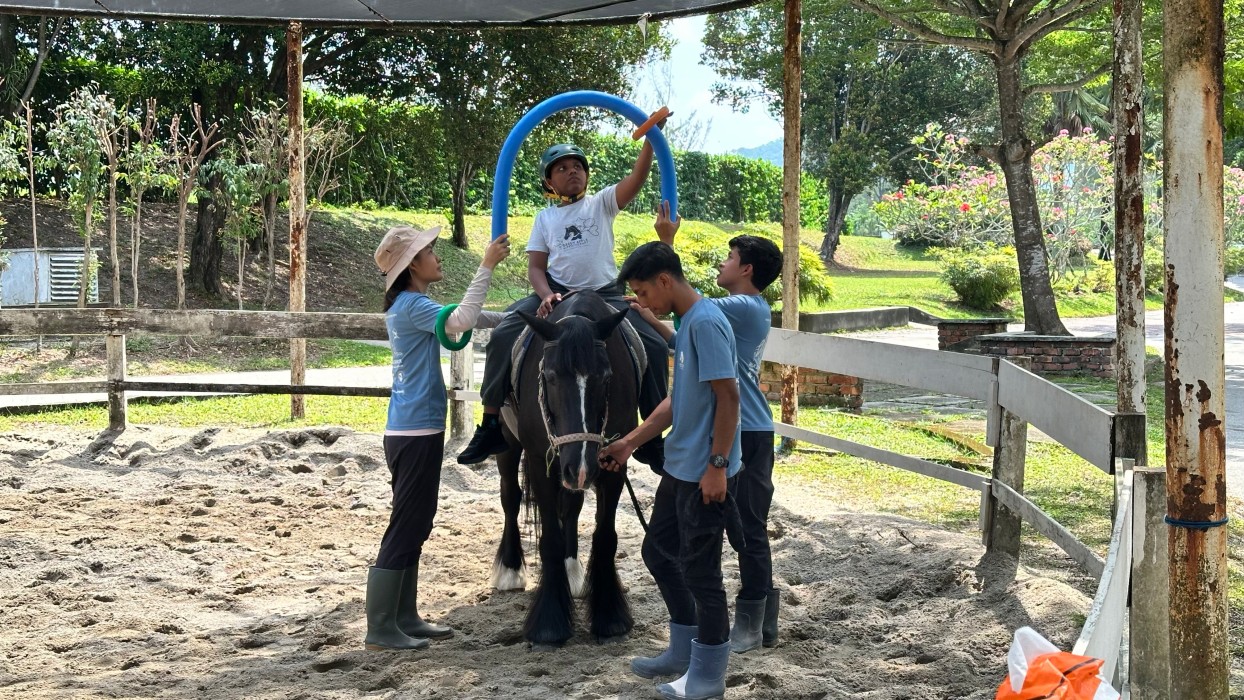
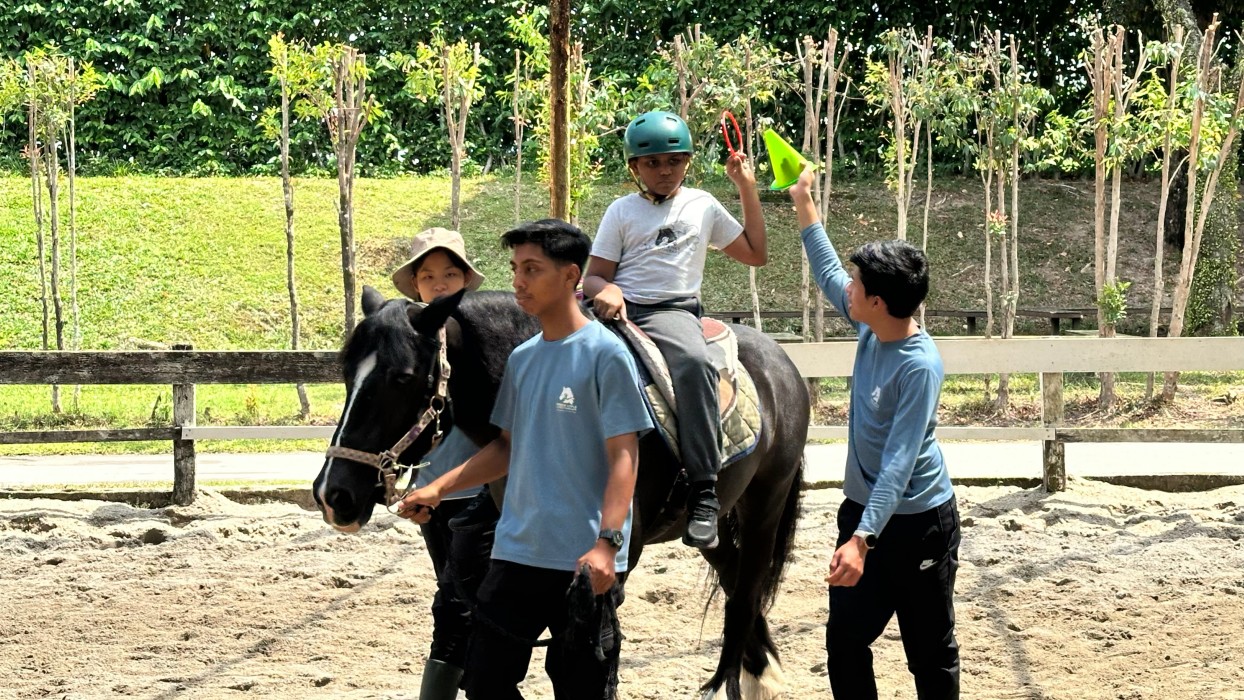
Each child works with a three-person team: a horse handler who controls the animal’s gate and rhythm, a licensed therapist, and a side-walker for safety. It is an intensely labour-driven model, and deliberately so.
Green Apple uses ponies for most of its young patients. This distinct breed is chosen for their smaller size, calm temperament, wide and strong backs, and ability to tolerate a child who may be frightened or physically resistant at first.
“We choose horses that can withstand this kind of situation, very calm, very tolerant. We call it bombproof.”
– Iliza Ikhbal, CEO
Most children adapt quickly. For those who struggle in the first session, Iliza describes what happens next: “Once they start moving, the body automatically reacts. The balancing apparatus starts to work. Once that comes into place, they start to enjoy it.”
The horse’s fur provides natural tactile input. Different terrain; zigzag, uphill, flat, creates varied sensory stimulation. Activities like sitting backward, reaching for objects, or tossing bean bags are woven into the session, all while the foundational movement continues to regulate the nervous system.
Parents consistently report the same observations after early sessions: their child slept better. They were calmer at home. More patient. These are the downstream effects of a regulated nervous system carrying that state home. That same regulated state also carries into their other therapy sessions. Children who attend hippotherapy regularly tend to get more out of their speech therapy, occupational therapy, and classroom time, because the brain that shows up to those sessions is already calm, open, and ready to absorb. As Dr Ali puts it, hippotherapy doesn’t replace what happens in the clinic. It makes everything else work better.
Beyond Autism: Who Hippotherapy Helps
Conditions Treated at Green Apple:
- Autism spectrum disorder– sensory regulation, focus, speech, social readiness
- Cerebral palsy– muscle strength, gait, balance, range of motion
- Down syndrome- motor development, cognitive stimulation, walking milestones
- Sensory processing disorder- multi-channel sensory integration
- Developmental delays- general motor, speech, and behavioural development
For children with cerebral palsy, the horse’s movement teaches the body how to walk. “Because the movement of the horse is exactly like a human being walking, they learn how to walk with better gait, better balance, better strength,” explains Dr Ali. Children who would otherwise walk late or walk poorly show measurable improvement in stride and stability.
For children with Down syndrome, hippotherapy addresses both the cognitive and physical dimensions of the condition, stimulating the brain while building the core muscle strength that delays independent walking for many of these children.
Mikhail’s Story: The Son Behind The Centre
A FOUNDER’S PERSONAL JOURNEY
He couldn’t tolerate a haircut. Now he holds a driving licence.
Iliza Ikhbal did not come to hippotherapy through a textbook. She came through her son.
Mikhail was not formally diagnosed until he was six years old, yes a little late, even though his father – a paediatrician, had begun quietly adapting the family’s approach much earlier. He removed gluten, dairy, and sugar from Mikhail’s diet. He monitored. He waited.
Mikhail began reading at two and a half. But when he started school, the gaps became visible; social behaviour, speech difficulties, an inability to tolerate sensory input that others barely noticed. Cutting his nails required four people holding him down. A haircut was a crisis.
“It manifests in what looks like bad behaviour,” Iliza recalls. “You have to backtrack and understand what is actually happening.”
Once formally diagnosed with sensory integration disorder and autism, Mikhail began occupational therapy. The OT who treated him later joined the Green Apple team, training in South Africa to deliver hippotherapy. Mikhail became one of the first children treated at the centre his parents built.
The changes came faster than expected. The daily body brushing and joint compression exercises Iliza had been doing at home, which was prescribed to regulate Mikhail’s hypersensitive nervous system, became unnecessary. “All of that is already being done when you’re sitting on a horse,” she says. “The horse’s fur does the body brushing. The movement does the joint compression. And the child is having fun.”
The meltdowns reduced. The anxiety lifted. Each Sunday, after his hospital rounds, Dr Ali would collect Mikhail and bring him to the stables for his session. Once a week. Consistently. For years.
Mikhail completed mainstream IGCSE education without a shadow teacher (a paid classroom assistant that many families of autistic children rely on). He is now 19, turning 20, and holds a driving licence.
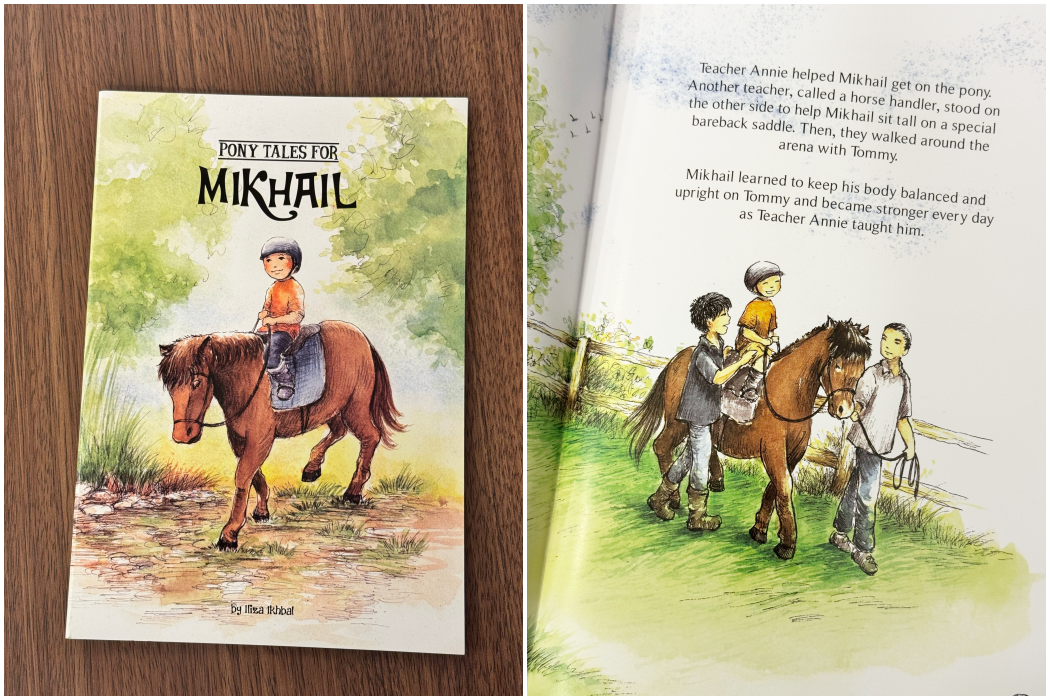
Iliza has written a book about this journey, which is self-published in 2020. “I’m not an author,” she says. “It’s just a personal story.” But that story, quietly shared, has become one of the most powerful things Green Apple offers parents who are just beginning.
Signs to Watch for in Your Child
Based on her own experience, Iliza urges parents to pay attention early, particularly in the first two years of life.
- Difficulty tracking moving objects with the eyes as a baby
- Extreme resistance to nail cutting or haircuts
- Avoiding eye contact or not responding to name
- Sensitivity to sound, light, or touch beyond what seems typical
- Speech delay or regression in language skills
- Social difficulties when starting school
“Straight away, make an appointment with a developmental specialist or paediatrician,” says Iliza. “Because sometimes you can really help in ways you don’t even expect – and the earlier, the better.”
Dr Ali echoes this. “The first two years have the best time for brain growth. Early diagnosis, consistent long-term treatment, and strong parental support; that is what makes the difference.”
Find Out if Hippotherapy is Right for Your Child
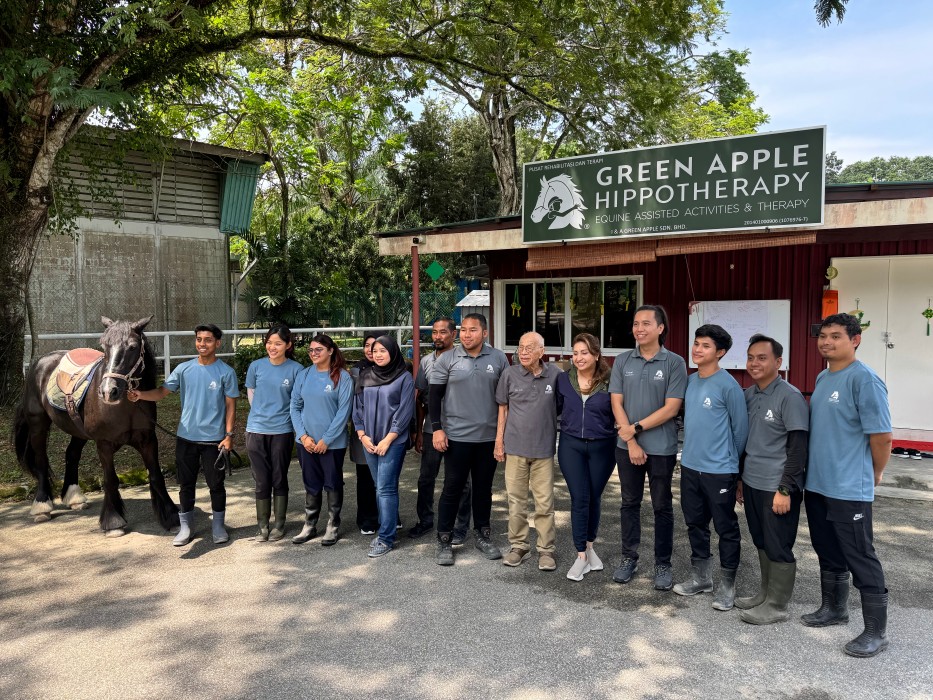
Every child at Green Apple begins with an assessment by Dr Ali Azman before sessions commence. The team currently runs two centres, one in Selangor Turf Club, Seri Kembangan, Selangor and another one that just recently opened earlier this year in Putrajaya, making hippotherapy accessible to families across the Klang Valley and beyond.
Website: greenapplehippotherapy.com
Phone: 016-376 1700
Email: hello@greenapple.com.my
Instagram: @greenapplehippotherapy