





DC Joo Yi, Webster Certified Chiro, Chirozone Family Chiropractic
Misalignment of the sacrum and pelvis is one of the main reasons for pregnancy-related problems such as backache, buttock pain, pubic pain, frequent urination, difficulty sleeping, round ligament pain and the list goes on. Did you know that a misaligned pelvis can also affect the baby’s position in the womb and indirectly affects the chances of natural delivery?
During pregnancy, hormonal changes can cause ligaments and joints in your body to stretch and become looser. These changes are necessary to prepare mum’s body for labour and also to accommodate the growing baby. However, the laxity & instability of the joints often lead to misalignment of the mum’s sacrum and pelvis during pregnancy.
Apart from that, with the baby’s weight getting heavier each day, the body’s center of gravity changes, which then causes most pregnant mums to have an overarched lower back. This increased strain and pressure can also cause the sacrum and pelvis to be out of their normal alignment.
DID YOU KNOW?
A misaligned pelvis can affect the baby’s position in the womb and indirectly affects the chances of natural delivery?
While misalignment of the sacrum and pelvis can cause discomfort, aches & pains to the mum, it can also indirectly affect the baby’s positioning in the womb. Here’s why:
The baby in the uterus will always adapt to the environment and move into the most comfortable position. When the mum’s sacrum and pelvis are not properly aligned, this can cause imbalances of the surrounding muscles and ligaments, causing some to be over-stretched while others to be too tight. This external pressure leads to an imbalance in the uterus.

In an imbalanced uterus, the baby has less room for movement and may assume (breech, transverse position) as the most comfortable position. However, these are not necessarily the best possible positions for birth. The best possible position for babies to be born are usually the head down position, vertex, LOA (Left Occiput Anterior).
Therefore, it is important to make sure that the spine and pelvis are properly aligned to reduce tension on the uterus. This increases the chance and space for baby to move towards the best possible position for labor, which is the head down vertex position, LOA.
Correcting the misalignment in the pelvis also helps to improve the uterine function. With the baby in the best possible position for birth and an optimally functioning uterus, this increases the chance of natural delivery and shorter labour time.

Most babies turn head down, cephalic on their own before their due date. However, at 30-32 weeks, around 30% of babies are still in breech position and 3% of babies still remain in breech position at 37 weeks.
If your baby is still in a breech position after week 30 or 32, you may try this forward-leaning inversion exercise. It is commonly recommended for pregnant women without contraindications.
However, do consult with your gynae before trying this exercise. Don’t do these exercises if you have high blood pressure, increased risk of stroke, elevated amniotic fluid levels, placenta issues (including bleeding), reflux, heartburn or glaucoma. Stop the exercise and get assessed immediately if you have discomfort or severe pain that persists longer than a few minutes or if the baby starts having frantic vigorous movements.
FORWARD-LEANING INVERSION
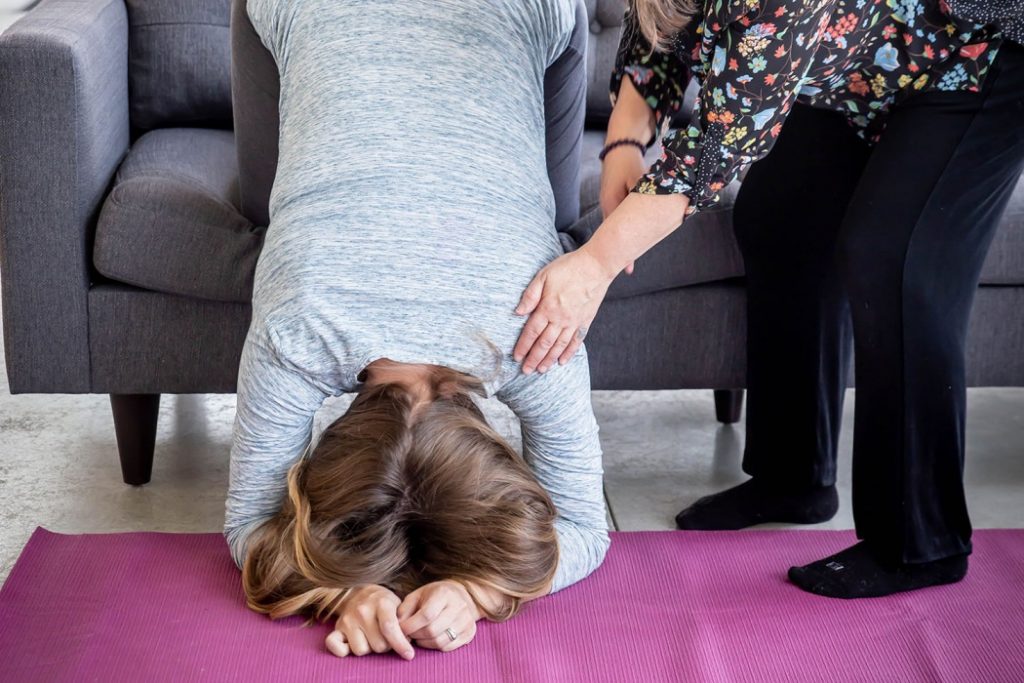
This exercise helps to lengthen the ligaments in the lower uterus to make room for the baby’s head.
- Be sure to do this exercise with a partner
- Kneel & hold on the edge of a sofa/bed/stairs with your knees placed apart to stabilize yourself.
- Slowly lower your body and put your hands on the floor. Then further lower yourself onto your elbows and forearms. Your partner can hold on to your legs for more stability.
- Your knees should be at the edge of the sofa/bed/stairs
- Don’t rest your head on the floor, keep your chin tucked.
- Your buttocks should be up high and straighten your lower back using your back and buttocks muscles.
- Take 5 breaths in this position and get back up. You can slowly advance to stay in this position for about 30-40 seconds before getting back up.
- Slowly come back to your hands, push yourself up to a high kneeling position. Take a few breaths. Then sit on your heels and rest.
- Be sure to move slowly. U can use pillows, towels or stool for assistance if needed.

If your baby is still in breech position, speak with your gynae, they may suggest and perform an External Cephalic Version (ECV).
Alternatively, you may look for a Webster certified prenatal chiropractor to help correct pelvic misalignment & improve baby’s positioning. A Webster certified prenatal chiropractor has undergone additional training to specifically assess and adjust pregnant mums’ sacral subluxation / misalignment.
The goal of Webster Technique is to reduce the effect of sacral subluxation or Sacroiliac joint dysfunction. By reducing the stresses being applied to the mother’s uterus, baby will have more room to move into the proper head down position, cephalic on his own. This can also help with shorter labor time too!
DISCLAIMER: Webster technique DOES NOT turn breech baby. Webster certified chiropractors help to optimise pregnant mums’ pelvic & uterine function so that the baby can have more room to move into the best possible position to be born, which is head down. Search for a Webster Certified Chiropractor near you on International Chiropractic Paediatric Association (ICPA)’s directory to help with your pregnancy journey.