



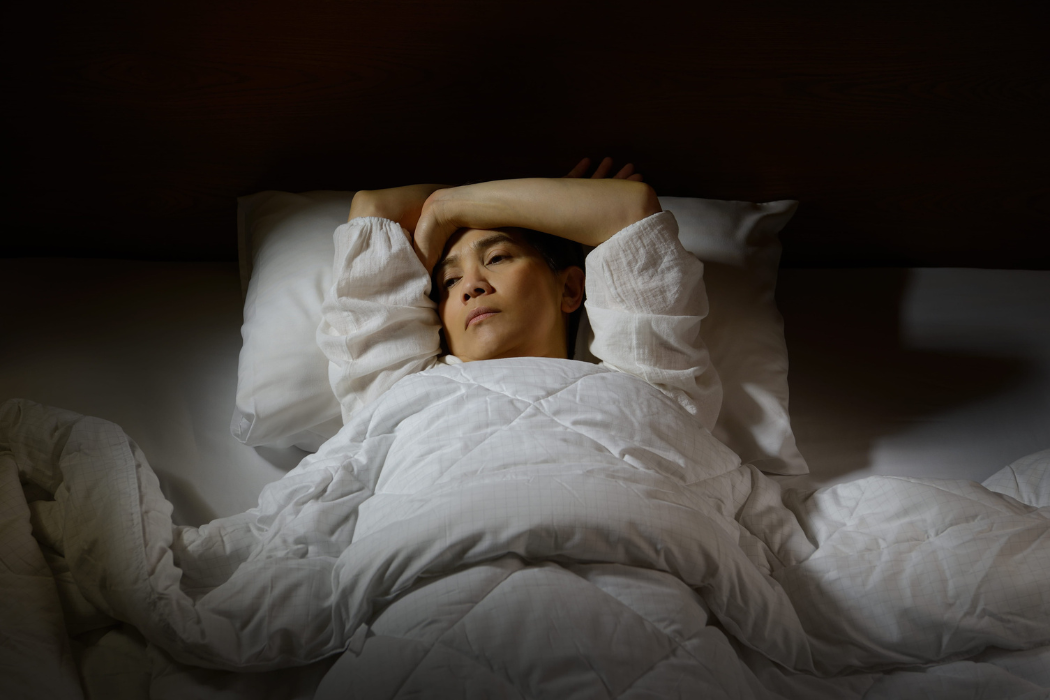


It starts the same way every night.
One minute you’re asleep. The next, you’re wide awake, staring at the ceiling while the rest of the house breathes in mocking silence. You check your phone and wonder why your body suddenly decided 3 am is the perfect time to be alert.
Sheets that felt perfectly fine two hours ago are now unbearably, inexplicably hot. You roll over, fluff the pillow, kick the blanket off, pull it back on again (to your partner’s annoyance), and somehow become painfully aware of every unfinished task and awkward memory all at once.
If this sounds familiar and you’re in your 40s or approaching your 50s, there’s a good chance this is not just stress or bad sleep habits. It could be perimenopause.
What’s Actually Happening to Your Body?
Perimenopause is the transition leading up to menopause, where hormone levels begin to fluctuate unpredictably. During this phase, oestrogen and progesterone levels no longer stay stable, and both hormones play a major role in sleep quality.
Research from the 2025 Journal of Clinical Medicine found that these hormonal fluctuations directly affect sleep, while symptoms like hot flushes and night sweats further interrupt the body’s sleep cycle.[1]
Progesterone naturally has a calming, sleep-supporting effect on the brain. When levels drop, sleep becomes lighter and more fragmented. You wake more easily, and staying asleep becomes harder.
Oestrogen also helps regulate body temperature. When it fluctuates, your body’s internal thermostat can feel completely off, which explains the sudden overheating in the middle of the night.

Why Your Brain Suddenly Won’t Switch Off
The exhausting part about perimenopause-related sleep disruption is that it often hits from multiple angles at once.
You wake up feeling physically uncomfortable, but then your brain suddenly becomes fully alert too. Hormonal shifts during perimenopause can affect anxiety levels, mood, and the brain’s ability to relax once it has been activated.
The same 2025 review also noted that sleep disturbances during perimenopause are frequently linked with anxiety, depression, and insomnia, making restorative sleep even more difficult.[2]
According to Dr Premitha Damodaran, Consultant Gynaecologist and Women’s Health Specialist at Pantai Hospital Kuala Lumpur, women who already experience sleep issues during their premenstrual phase may be more likely to face sleep problems during perimenopause as well. She also highlights that hormones are not always the only reason. Emotional stress, work pressure, mental load, and relationship dynamics can all add to the problem.[3]
And after weeks or months of broken sleep, it starts affecting everything else, too. Your concentration drops. Your patience gets shorter. Your mood shifts faster. What feels like “just poor sleep” slowly turns into something much heavier.
It’s More Common Than You Think
Many women assume they simply have to tolerate poor sleep as they get older. But the numbers tell a different story.
A study led by Dr Premitha involving 1,825 working Malaysian women aged 40 to 60 found that sleep disturbances were the second most commonly reported menopausal symptom, affecting 31.1 per cent of respondents.[4]
Researchers have also found that melatonin production and circadian rhythm can change during perimenopause, weakening the body’s natural sleep signals.[5]
A study led by Dr Premitha involving 1,825 working Malaysian women aged 40 to 60 found that sleep disturbances were the second most commonly reported menopausal symptom, affecting 31.1 per cent of respondents.
When Should You Stop Ignoring It?
The occasional bad night is just life. But if you’ve been waking consistently, feeling unrefreshed every morning, struggling to focus during the day, or noticing mood shifts alongside the sleeplessness, that deserves attention, not a shrug.
Speak to your doctor if the disruption has been going on for more than a month, if night sweats are waking you multiple times a week, or if your daytime functioning is genuinely taking a hit. These aren’t things to push through alone.

So, What Actually Helps?
The good news is that there are ways to improve sleep during perimenopause, and small lifestyle adjustments can make a real difference.
Some of the most commonly recommended approaches include:
- Keeping a consistent sleep schedule
- Sleeping in a cooler room
- Reducing caffeine and alcohol intake at night
- Managing stress more actively
For some women, Hormone Therapy may also help improve sleep quality and reduce symptoms like hot flushes, night sweats, and mood changes. Research supports its effectiveness in improving sleep and managing vasomotor symptoms linked to perimenopause.[6]
Non-hormonal medications and evidence-based supplements are also increasingly available options worth discussing with a healthcare professional.

The Bottom Line
Waking up at 3 am every night is not always “just part of getting older.”
Sometimes, it’s your body signalling that something is changing. And while perimenopause may be common, you don’t have to normalise it, and you certainly don’t have to figure it out alone.
Book the appointment. Have the conversation. Your sleep, and honestly, your sanity, is worth it.