







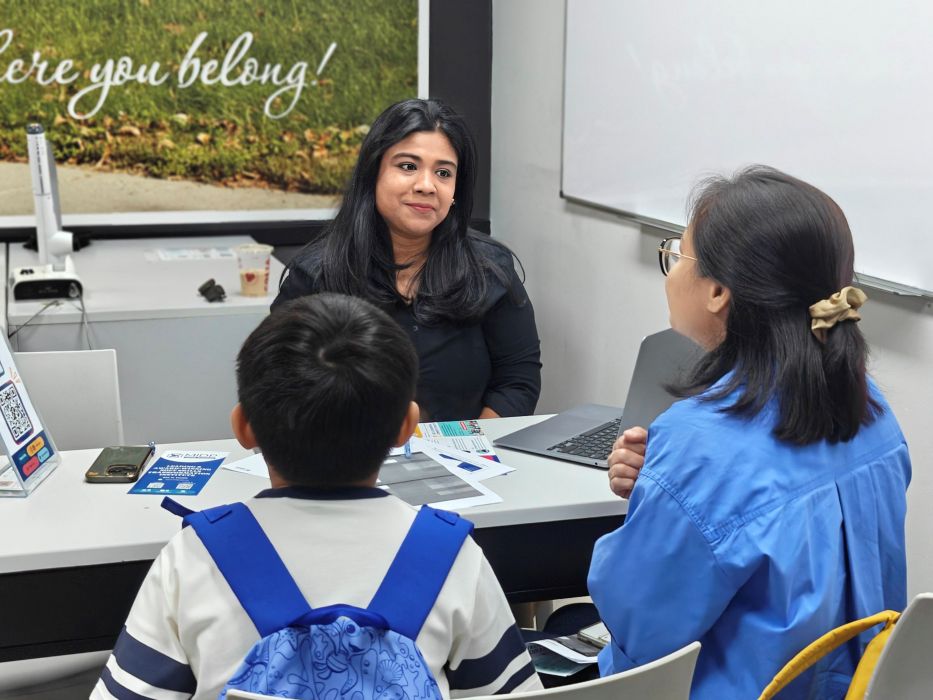
Emellia Shariff, Group CEO of MIDP Youth Institute
We now live in a world where answers are available at the click of a button. Generative AI is being used everywhere to do so many things. You can now quite easily summarise complex literature, solve mathematical equations, and lately, have you noticed the surge of AI-generated posters and restaurant menus?
While technology brings undeniable convenience, it raises a vital question for parents: as digital shortcuts multiply, how do we ensure our children continue to develop genuine, independent thought?
For Emellia Shariff, Group CEO of MIDP Youth Institute, the priority is clear. Children need to develop the foundations of thinking first, before technology begins doing too much of that thinking for them.
Re-Evaluating Confidence and Technology
In many settings, confidence is mistaken for volume. We often assume the child who speaks the loudest or commands the room is the most confident, but real confidence is actually a learnable skill that is built on a quiet sense of self-worth and knowing that making a mistake isn’t the end of the world.
“Genuine confidence is a skill built on the quiet trust that one will be okay even in the face of failure or imperfection,” Emellia notes. “By mastering core non-verbal cues such as steady eye contact, vocal modulation, and positive body language, both quiet introverts and naturally vocal children can learn to present themselves to the world with authentic assurance.”
When children rely heavily on conversational AI during their formative years, they miss out on essential mental exercises. The brain needs to read, process, and synthesise information independently to build strong neural pathways. Bypassing this effort creates a risk of diminishing critical thinking, wisdom, and cognitive sharpness over time.
For parents looking to introduce technology early on, Emellia suggests shifting the focus away from generative tools. Teaching children coding, for instance, offers a far more constructive outlet.
“Coding builds true problem-solving skills, resilience, and grit,” she explains. “Kids should be able to have the ability to think first before having the ability to use AI as a tool.”

Let Them Disagree, Respectfully
Confidence also means giving children room to question, disagree and be challenged. For many parents, particularly in Asian households, this can feel uncomfortable, especially when questioning is easily mistaken for “talking back”. But Emellia believes this kind of friction is important, both for independent thinking and for learning how to handle real relationships.
There is also a social cost. AI can be highly validating, while real people will not always agree with us.
This is why she sees structured debate as such an important skill. Rather than teaching children to argue louder, it teaches them to listen properly, consider another perspective, find common ground and, when necessary, rethink their own position. Over time, disagreement becomes less about something to fear and more about something they know how to navigate with confidence, empathy and respect.
“Structured debate is a mental exercise that teaches children to separate opinions from personal feelings and view disagreement objectively,” Emellia explains.

Practical Habits for the Home
Parents do not need a curriculum to start. Emellia’s suggestions are small enough to fit into an ordinary Tuesday:
- Give them 10 minutes of undistracted conversation. Put the phone away and genuinely talk, even while doing something as ordinary as preparing dinner.
- Offer choices. Instead of asking an overwhelmed child, “What do you want?”, start with two options and let them make a decision.
- Make “why?” a curious question. Ask why they love a particular dinosaur, football team or hobby, then encourage them to explain their reasons.
- Do not shut down uncomfortable questions. Help children learn whether they are asking from curiosity, care or challenge, and how to phrase their thoughts respectfully.
The goal is not to raise children who question everything for the sake of it, but to raise children who know how to question.

Building Skills AI Can’t Replace
Emellia’s core message for parents is clear: beyond keeping our children safe, our true task is empowering them to thrive. That starts with getting to know the unique individual they are becoming, listening to their perspective, and giving them the space to form a voice of their own.
At MIDP Youth Institute, this philosophy is brought to life through experiential learning designed to sharpen communication, competency, and critical-thinking skills well beyond memorised answers. Through public speaking, scholastic and competitive debate, Model United Nations, storytelling, and other dedicated youth development programmes and competitions, children learn to navigate real-world dialogue with poise.
Recognised as Best Soft Skills Transformation Institute at the recent 2026 Parents’ Choice Awards, MIDP Youth Institute gives children a safe space to stumble, question, reconsider and, eventually, find their own voice – AI or no AI.
Discover how MIDP Youth Institute nurtures confident and competent critical thinkers for the future at midp.edu.my.